Read further

The Executive Field Guide
Explore the ideas in more depth and work through them at your own pace.
Access the Field Guide
When performance is getting harder to rely on
If you recognize these signals, weaknesses may be affecting more than the issue you first noticed.
Recognize Your Problem
When the same issues keep returning, there may be more to understand than the latest incident.
Warning signs
One signal can have a straightforward explanation...
Several signals together, or signals that persist despite repeated effort to resolve them, may point to a much wider problem.
Why look closer?
Unresolved problems can consume time and money, limit room to act, strain relationships, stifle innovation or make change harder to achieve.
In a business, that might affect cash, customers or suppliers.
In other organizations, it may affect budgets, service commitments, public confidence or the ability to meet the needs of members, clients or communities.
A sudden event can bring the pressure into view:
The event may be new. The underlying weakness may not be.
A name for this pattern
Organizational Drift is when an organization keeps adapting around weaknesses instead of correcting them at source.
People add workarounds, extra checks and more coordination to keep things moving.
A few individuals can become the go-to people, often taking on work beyond their usual roles.
Results may still look fine, while reliable performance takes more effort to maintain.
Select Your Situation
We can see the problems, but not how they connect or what needs attention first. We need help navigating our challenges and prioritizing action.
Explore your situation Regain organizational controlThe pressure is building. The same few people are stretched, often working beyond their usual roles. We cannot keep relying on extra effort and workarounds.
Explore your situation Change how work gets doneThe organization has plans, demand or changes ahead. Its current way of operating is already creating difficulty, or may do so in the short to medium term.
Explore your situation Recovery and transformationStabilizing operations may reveal where the operating model needs to change.
Explore your situation →These choices are a starting point. More than one approach may apply.
A conversation may help clarify which route, or combination, fits your situation.
A clearer picture · RADAR
Sometimes the problems are visible, but their causes and connections are not.
RADAR helps you understand what is happening within your organization, where the weaknesses sit and what options are available.
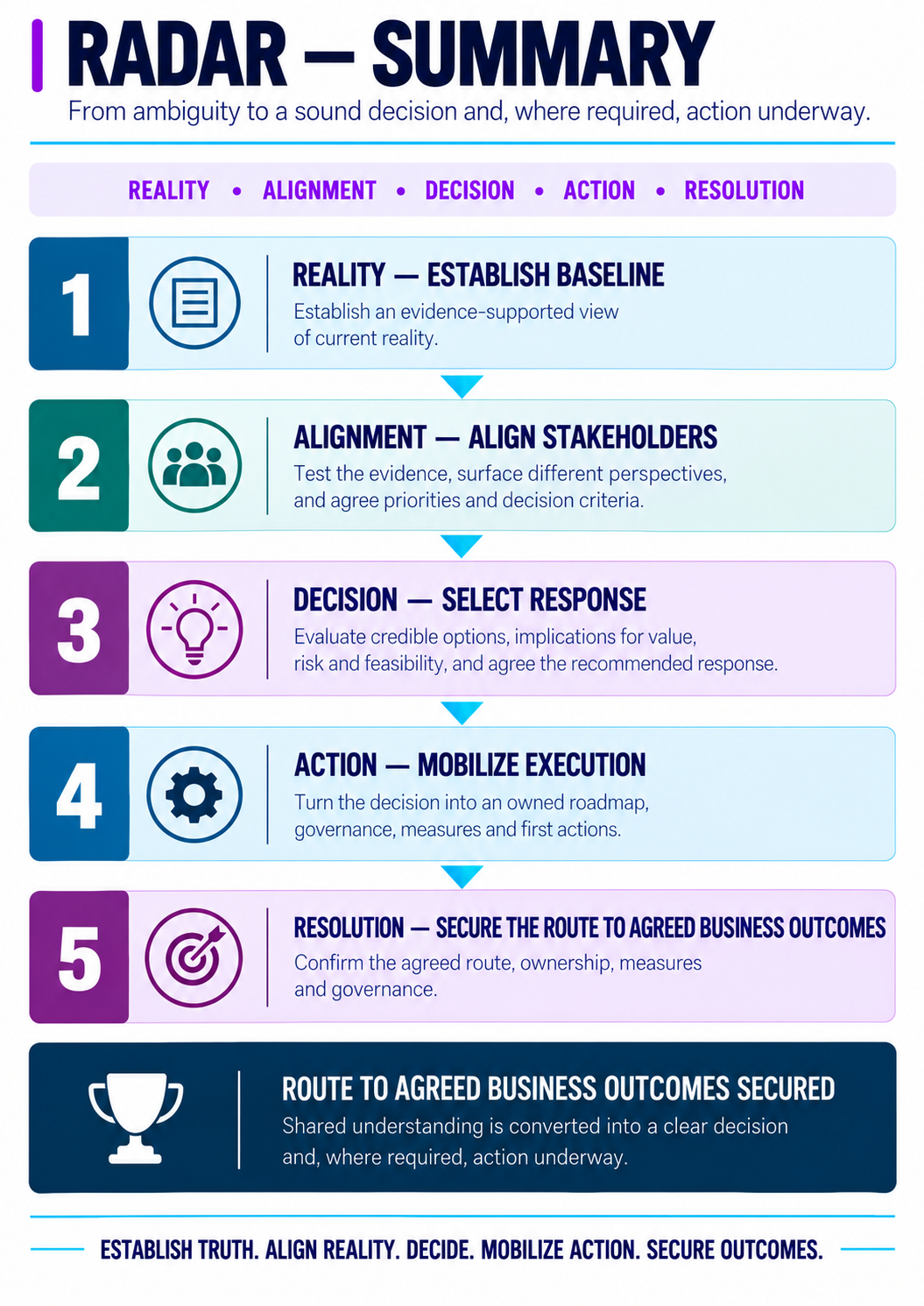
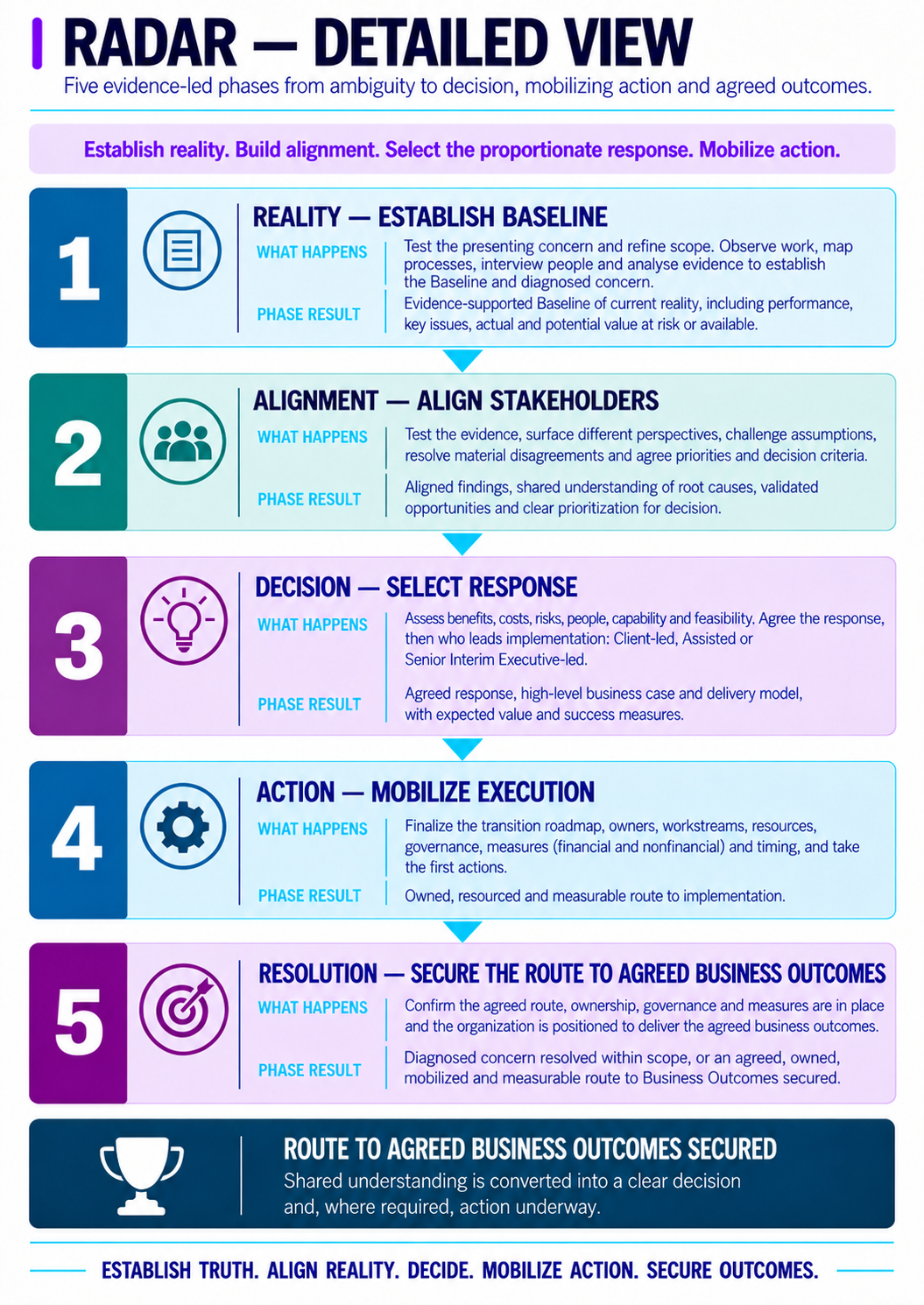
We begin with the client’s presenting concern: the initial description of what appears to need attention. We examine work, processes and evidence to establish an evidence-supported Baseline and the diagnosed concern. Evidence may confirm, refine or change the original concern.
We test what we find with the people involved, agree what matters, and compare practical options before deciding what should happen next.
Listen to senior leaders’ views of the problem, then confirm the scope. Observe how work is done, review relevant processes and data, and establish what is happening now.
Share the findings with stakeholders. Test the evidence, surface different perspectives, challenge assumptions and confirm the weaknesses involved. The findings workshop creates a shared view of what the evidence shows.
Compare practical responses, benefits, costs, risks and feasibility. First agree the proportionate response. Then select the implementation delivery model: Client-led, Assisted or Senior Interim Executive-led. These are separate decisions, made before finalizing the Transition Roadmap.
Set out owners, the practical route, resources, measures and first actions. Your team can lead with Gary supporting, or you can sponsor Gary to lead agreed work in close liaison with you.
Resolve the diagnosed concern within scope, or secure an agreed, owned, mobilized and measurable route to Business Outcomes. Confirm ownership, governance and measures, distinguishing results already demonstrated from outcomes still to be delivered.
RADAR does not force a preselected solution. The evidence may support no major intervention, bounded further inquiry, a bounded correction, a Senior Interim Executive-led assignment that is neither RPR nor OMT, recovery, transformation or an explicit combination of RPR and OMT. Your situation determines the route.
The diagram below shows the five phases at a glance. Open the detailed view to examine each phase more closely.
Reliable Performance Recovery (RPR)
Sometimes the organization is overwhelmed and has lost the capacity
to restore control through its current response.
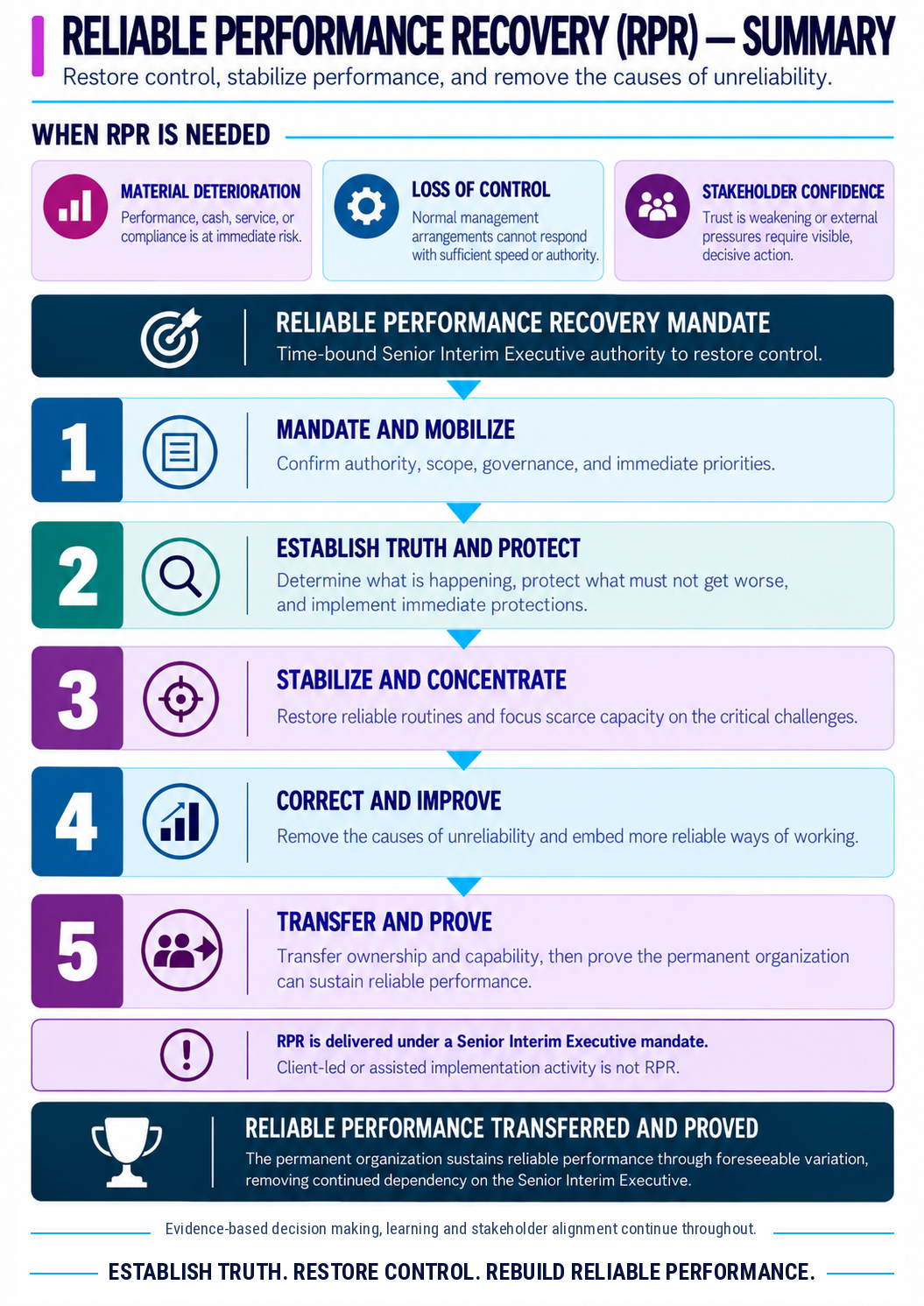
Reliable Performance Recovery (RPR) is for situations where performance has become unreliable and the organization cannot restore control through its current response.
Gary takes on interim executive responsibility to stabilize immediate operations, address the weaknesses driving the problem and lead a practical recovery.
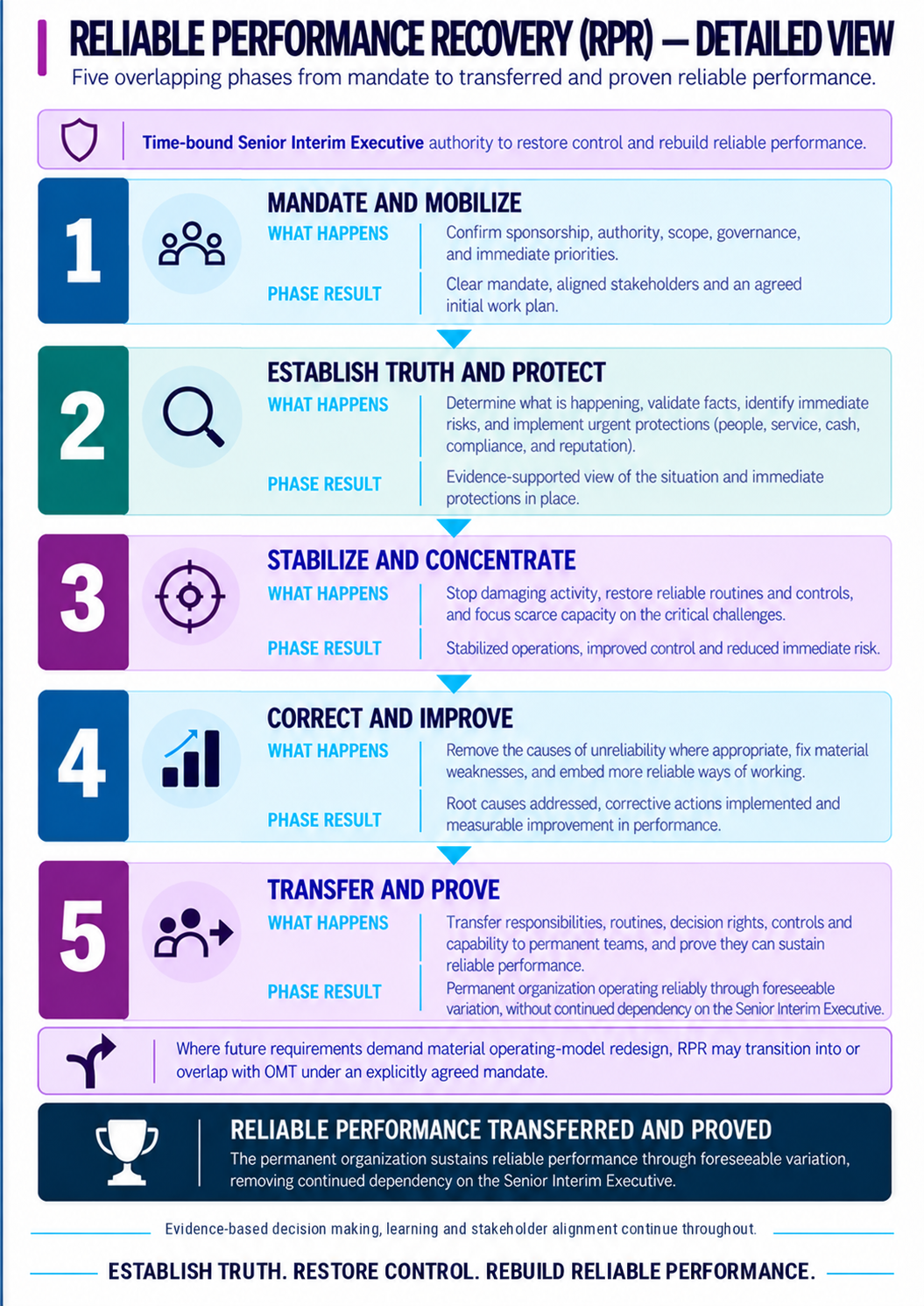
Confirm sponsorship, authority, scope, governance and the immediate priorities.
Find out what is happening, validate the facts, identify immediate risks and put urgent protections in place.
Stop damaging activity, restore reliable routines and controls, and focus scarce capacity on the critical challenges.
Address the causes of unreliability, fix material weaknesses and embed more reliable ways of working.
Transfer responsibilities, routines, decision rights, controls and capability, then prove the permanent team can sustain reliable performance through foreseeable variation.
RPR begins with a clear mandate, protects and stabilizes immediate operations, addresses the weaknesses behind the problem, and transfers ownership and capability before proving that the permanent team can sustain reliable performance.
RPR requires a time-bound Senior Interim Executive mandate. Client-led or Assisted recovery activity alone is not an RPR mandate. You remain the sponsor and stay closely involved while Gary holds the agreed interim authority and leads the recovery. If the evidence shows that structural operating-model change is needed beyond the recovery mandate, the work can transition into Operating Model Transformation (OMT) or a defined combination of approaches.
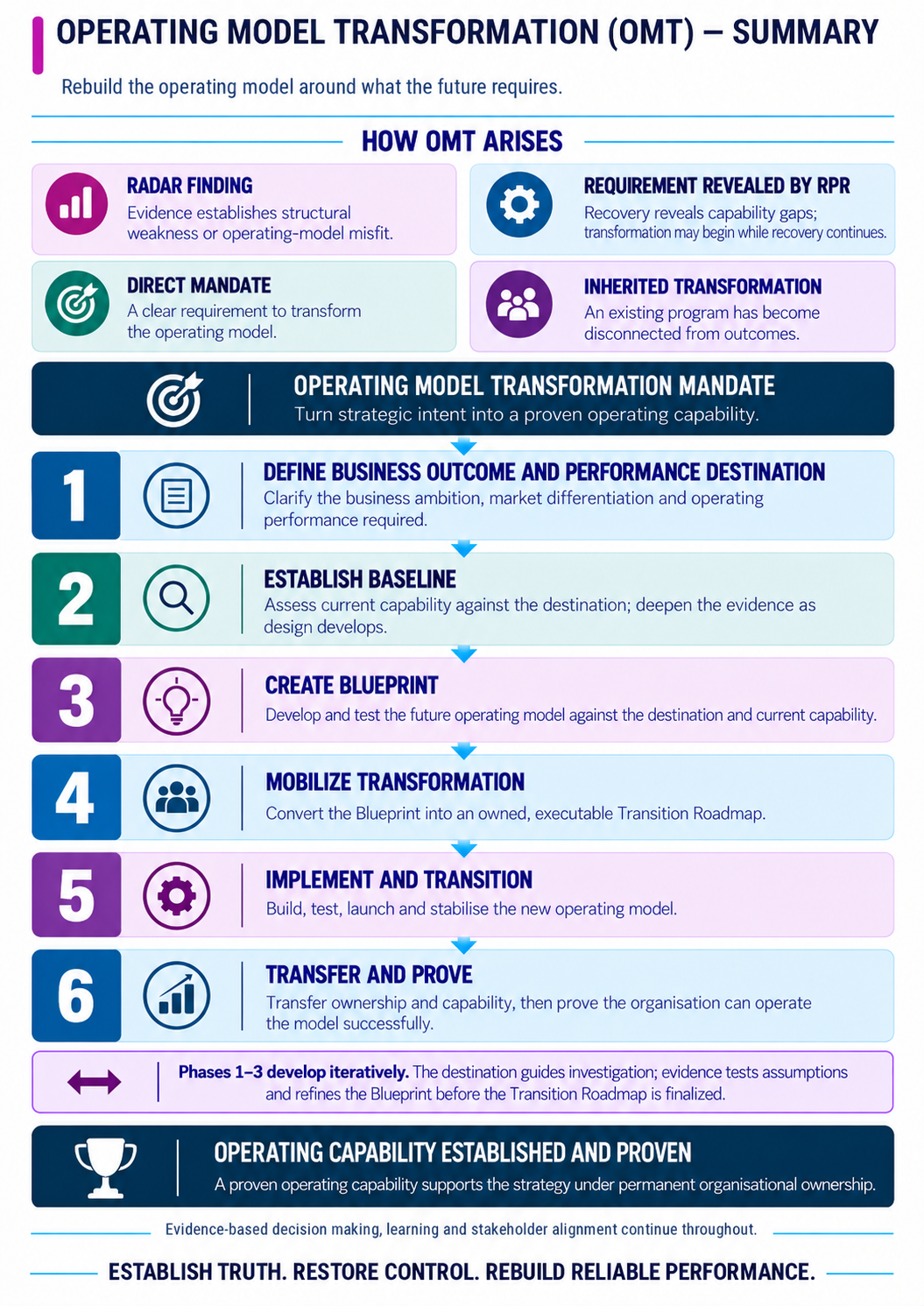
Change how work gets done · OMT
Sometimes the organization’s way of working no longer fits what it needs to achieve.
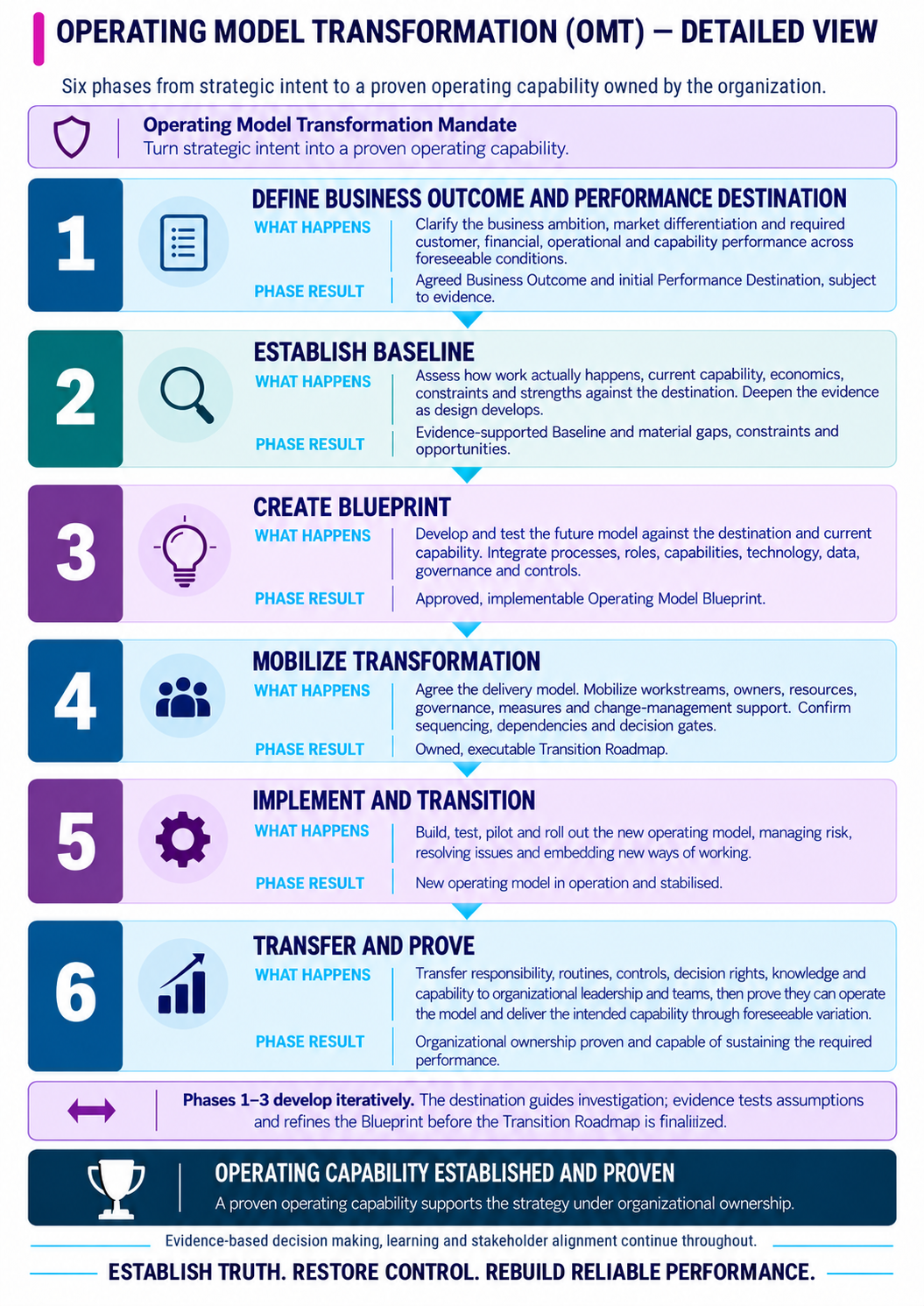
Operating Model Transformation (OMT) is for an organization whose current way of operating may not support what it needs to deliver next.
Having defined the performance destination, we work with you to understand current reality, design a workable future model, agree the changes required and work with you to deliver them.
Five assessment questions help determine whether bounded improvement, selective change or transformation is justified. They are practical questions for investigation, rather than sequential stages. A failed test prompts investigation into execution, design or both; it does not automatically justify transformation.
Clarify the business ambition and measurable customer, financial, operational and capability performance required through foreseeable conditions. The initial destination remains subject to evidence.
Assess how work happens, current capability, economics, constraints and strengths against the destination. Deepen the evidence as design develops.
Design the operating model required to achieve the performance destination.
Turn the blueprint into owned workstreams and an executable transition roadmap, with scope, sequence, resources, governance and decision points.
Build, test, pilot and roll out the new operating model, managing risk and resolving issues as the changes take effect.
Transfer ownership and capability, then prove the organization can operate the model and deliver the intended capability through foreseeable variation.
Operating Model Transformation may follow diagnostic findings, a recovery requirement, a direct mandate or an inherited transformation.
The six phases take the organization from current reality to a proven operating capability.
Phases 1–3 develop iteratively. The destination guides investigation; evidence tests assumptions and informs design; emerging designs identify where deeper investigation is needed. The agreed destination, Baseline and approved Blueprint support finalizing the Transition Roadmap.
OMT may be Client-led, Assisted or Senior Interim Executive-led. Scope, authority and accountability must be explicit. In Client-led work, your team owns continuing implementation, transfer and proof. In Assisted work, your team retains executive accountability while Gary supports defined needs. A Senior Interim Executive-led mandate gives Gary time-bound authority and accountability for agreed work. These arrangements may change by explicit agreement. Completion of Gary’s external mandate does not necessarily mean the wider transformation is complete: distinguish capability established, benefits demonstrated, results awaiting confirmation and continuing responsibilities.
How the services fit together
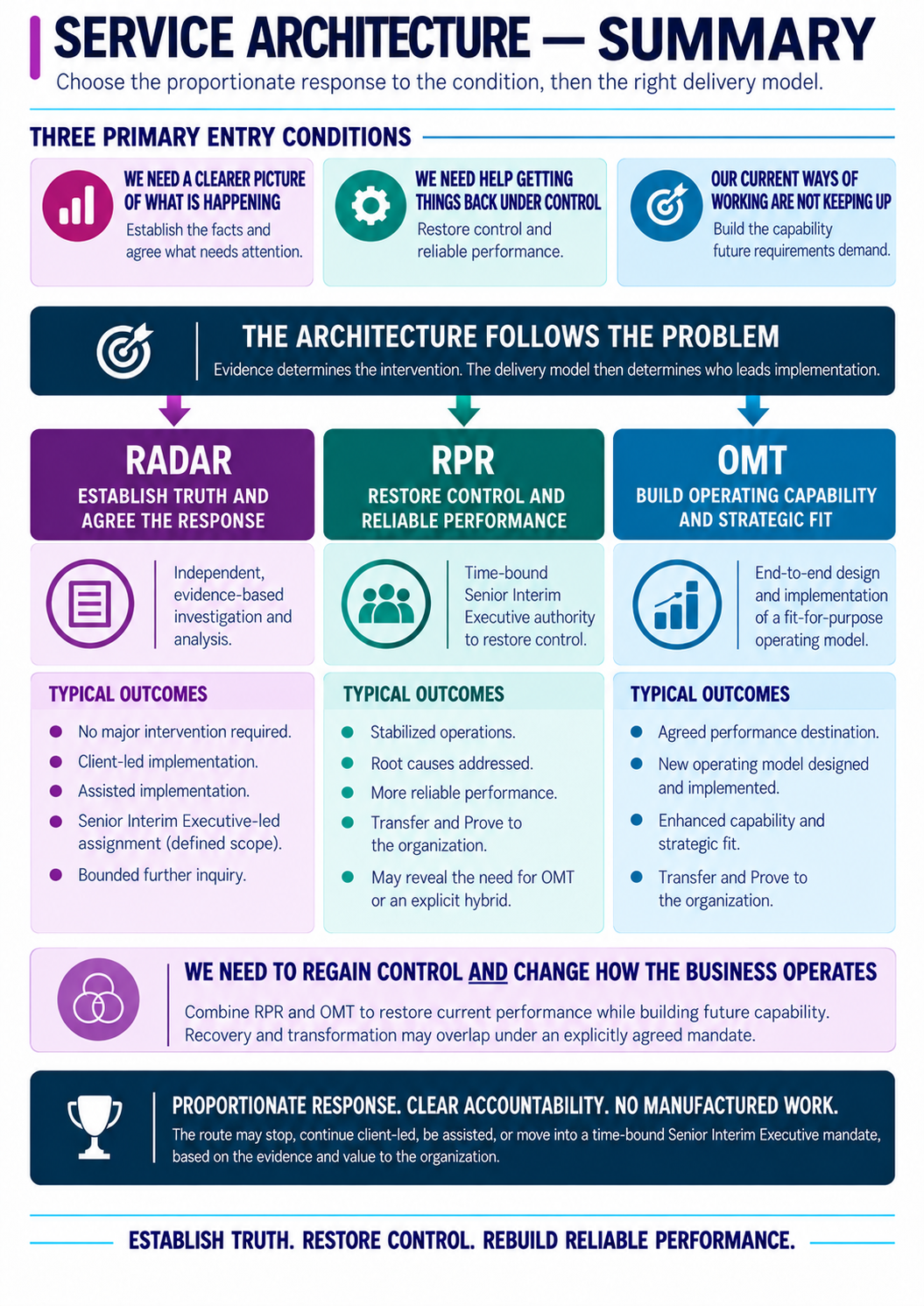
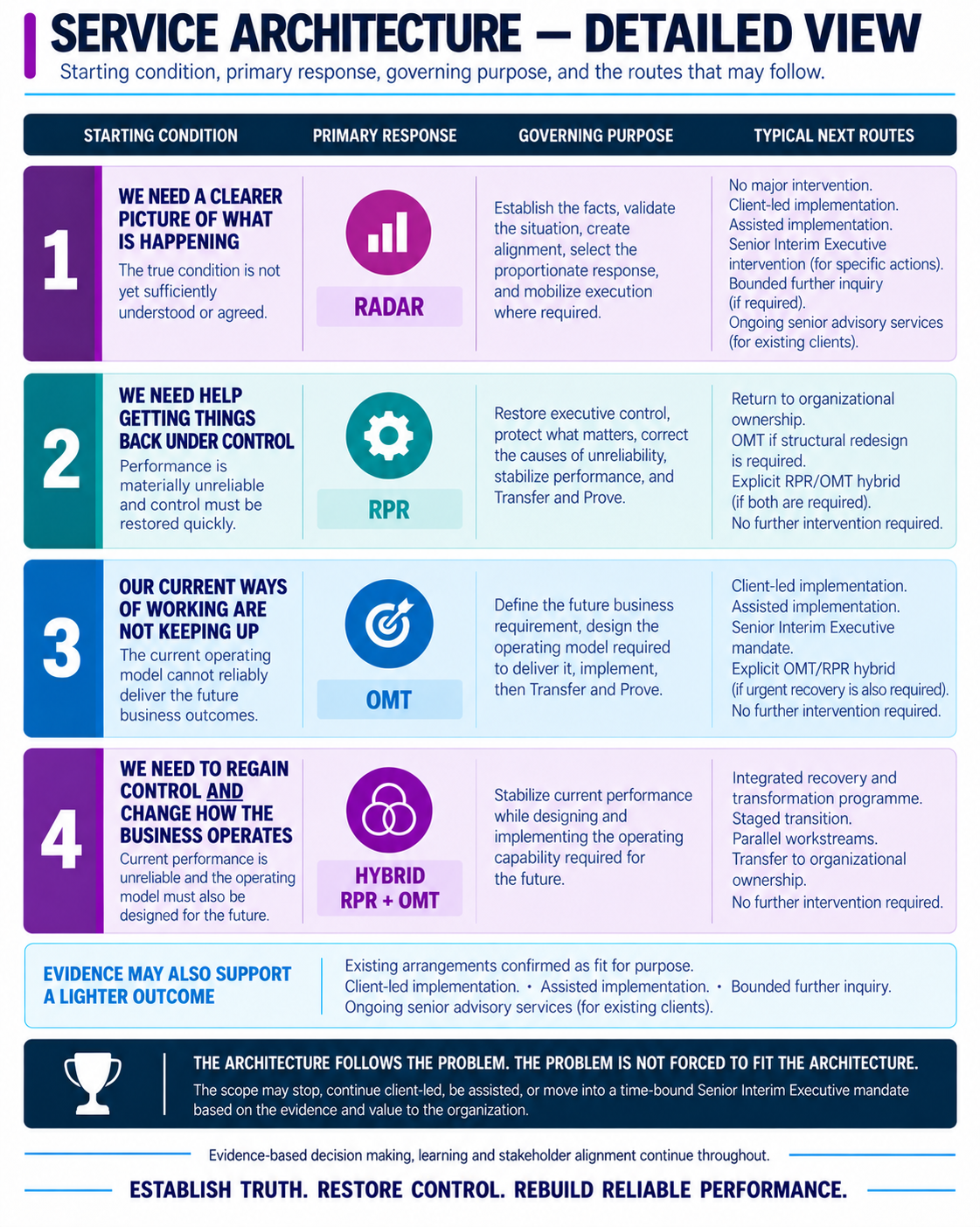
The starting condition points to a proportionate response. Evidence determines the intervention; the delivery model determines who leads implementation.
RADAR establishes what is happening and what response is justified. The evidence may support no major intervention, bounded further inquiry, a bounded correction, a Senior Interim Executive-led assignment that is neither RPR nor OMT, Reliable Performance Recovery, Operating Model Transformation, or an explicit combination of RPR and OMT. Response selection determines what is needed; the separate delivery-model decision determines who leads implementation and with what authority and accountability. RPR requires a time-bound Senior Interim Executive mandate; OMT can be Client-led, Assisted or Senior Interim Executive-led. The work can stop when the evidence shows no further intervention is needed.
RADAR · Detailed view
The detailed RADAR view explains the evidence-led phases from establishing reality through alignment, decision, action and resolution.
RPR · Detailed view
RPR requires a time-bound Senior Interim Executive mandate when performance is materially unreliable and current efforts have not restored control. Client-led or Assisted recovery activity alone is not an RPR mandate.
OMT · Detailed view
OMT changes the operating model when it can no longer reliably meet the organization’s requirements or destination.
The pattern underneath
Organizational Drift describes what happens when an organization keeps adapting around weaknesses instead of correcting them at source.
The work still gets done. Results may still look fine, but more effort goes into compensating. People add workarounds, extra checks and more coordination to keep things moving. A few individuals can become the go-to people, often taking on work beyond their usual roles. Over time, the organization can become dependent on those individuals and arrangements.
Results may still look fine while reliable performance takes more effort to maintain. That makes it harder to deliver what the organization needs reliably.
Read further
Explore the ideas in more depth and work through them at your own pace.
Access the Field GuideQuick reference
The definitions from the Field Guide will be available here once the guide is complete.
Explore the definitionsExplore further

Hybrid RPR-to-OMT
Recovery starts with an agreed interim mandate to protect operations and restore control. The work may establish that the business needs a different operating model to sustain performance or meet future demands.
When the evidence supports both, recovery can transition continuously into transformation and may overlap with it under an explicitly agreed mandate. This combines RPR and OMT; it is not a separate methodology or a compulsory service. Agree objectives, authority, accountability, resources, governance and dependencies for both responses. Recovery reaches Transfer and Prove when permanent leadership owns and demonstrates sustainable reliable performance. Record recovery already completed separately from transformation still underway. Ending an external mandate does not establish that the wider transformation is complete.
Evidence in practice
Establish what is happening and agree what to do next.
Explore examples →Three Practical ExamplesRestore control and transfer reliable routines to the permanent team.
Explore examples →Three Practical ExamplesDesign and put in place the operating model the business needs.
Explore examples →Three Practical ExamplesRestore control & redesign operations when the evidence calls for both.
Explore examples →Practical Examples
Establish what is happening and agree what to do next.
A luxury retailer holding $225 million in inventory could not explain recurring stock discrepancies exceeding $15 million, while each stock-take took six months to reconcile.
Valuable merchandise left stores without dependable records, operational accountability was weak, and Finance was left reconstructing transactions long after they occurred.
Gary Newbury traced the discrepancies to their causes, directed a redesigned stock-take and established practical recording, recovery and audit arrangements.
Inventory variances fell to $2 million, reconciliation dropped to three weeks, and management regained visibility over $75 million of inadequately controlled inventory, demonstrating why reliable reporting begins with operational accountability.
Read the full Practical ExampleA major investment was approved and a project team appointed, yet eight months of activity had failed to produce an executable relocation plan as the deadline approached.
Unreliable capacity assumptions, fragmented accountability and excess inventory threatened to build existing weaknesses into an expensive new operation.
Gary Newbury challenged the calculations, directed physical product measurement and developed an operating blueprint with an integrated implementation programme.
The CEO accepted the blueprint, $8 million in excess inventory was exposed, and accountable workstream owners were mobilized around a plan supporting a $5 million fit-out budget and targeted $1.4 million annual operating savings.
Read the full Practical ExampleA sophisticated manufacturer produced excellent products but repeatedly failed to deliver complete installation kits, leaving crews stranded, customers frustrated and project managers chasing missing components.
Poor component identification, fragmented responsibility between manufacturing and warehousing, and inadequate performance visibility prevented the business from turning production output into dependable customer delivery.
Gary Newbury established the causes, worked with a manufacturing consultant to introduce immediate tracking controls and designed an integrated warehouse operation.
Complete and on-time fulfilment improved from 20% to over 80% within weeks, while a $125K investment case established a route to permanent improvement with projected annual savings of $125K.
Read the full Practical ExamplePractical Examples
Restore control and transfer reliable routines to the permanent team.
Appendices 9 and 10 illustrate Senior Interim Executive-led RPR mandates. Appendix 11 shows related recovery through a third-party provider under client executive sponsorship; the provider retained operating authority.
A $25 million manufacturer recorded a $2 million monthly loss despite substantial revenue, established customers and a busy workforce.
Unreliable financial reporting concealed the deterioration, while loss-making contracts and disconnected commercial, production and purchasing decisions continued to destroy value.
Appointed Interim COO, Gary Newbury established financial visibility and led coordinated changes to commercial terms, management accountability, production performance and inventory control.
Profitability returned within five months, fulfilment reached 97%, and a successful trade sale followed six months after his appointment, preserving a business facing an estimated $10 million closure exposure and giving its owner a materially better exit.
Read the full Practical ExampleAn established logistics business was losing money despite occupied warehouses, major customers and a dedicated transport operation, leaving its owner with substantial activity but inadequate returns.
Seasonal facilities had become continuing liabilities, customer rates failed to recover service costs, and a flagship transport contract depended on schedules that could rarely be achieved.
Appointed Interim COO, Gary Newbury exited five leased warehouses, renegotiated or relinquished uneconomic work and strengthened management accountability.
The business returned to profitability with $1.7 million in recorded financial improvement during the assignment, while early results from restructured haulage supported an estimated $1.25 million annualized benefit.
Read the full Practical ExampleA major business outsourced a critical distribution operation, then faced an immediate service meltdown as receiving capacity was overwhelmed and customer orders could not be reliably fulfilled.
Gary Newbury exposed weaknesses in capability assurance, operating design and readiness, then drove corrective action through the provider’s senior management and the client’s executive sponsorship.
Despite resistance and without direct command of the provider’s workforce, he secured changes that restored service to pre-transfer benchmarks within six weeks and substantially improved productivity.
He subsequently redesigned a replacement facility, establishing a route to stronger operating capability and a projected combined value opportunity exceeding $10 million.
Read the full Practical ExamplePractical Examples
Design and put in place the operating model the business needs.
A major retailer’s furniture promotion failed despite the addition of 16 temporary warehouses, leaving stores with willing customers but without dependable access to the stock they needed.
Manual controls, repeated stock movements, inaccurate capacity records and poorly allocated inventory concealed substantial potential within the existing network.
Gary Newbury measured storage capacity, analysed inventory and redesigned specialist storage so bulky lighting products could move out of the principal distribution centre.
The completed relocation released valuable capacity, while his analysis established a $100 million inventory improvement opportunity and a practical planning model for assessing future promotions before committing more resources.
Read the full Practical ExampleA $25 million international accessories supplier planned to triple sales, but its existing supply chain struggled to respond to changing customer requirements.
Inventory was scattered across regional warehouses, routine replenishment took six to eight weeks, and urgent orders required expensive emergency air freight.
Gary Newbury redesigned inventory positioning, product configuration, fulfilment, transportation and supporting systems into a faster, simpler global operating model.
Working with the CFO, he established $8 million in projected annual savings and subsequently helped initiate warehouse rationalization, inventory reduction and operating changes towards a 48–72-hour global service objective, before the client continued implementation.
Read the full Practical ExampleCustomers could receive excellent replacement-parts service one day and face substantial delays the next, making it difficult to plan work or trust delivery commitments.
Undifferentiated inventory policies and disconnected manufacturing, purchasing, system and warehouse arrangements left service dependent on whatever stock happened to be available.
Gary Newbury developed a new aftermarket operating model built around four product-based service commitments and assisted implementation of the supporting operating changes.
Next-day fulfilment for stocked products subsequently exceeded 90%, while clearer commitments, faster receiving and disciplined order processing gave the business a more predictable and commercially appropriate way to serve customers.
Read the full Practical ExamplePractical Examples
Restore control and redesign how the business operates when the evidence calls for both.
A logistics provider approached insolvency despite a full warehouse and growing demand, with congestion, service failures and losses exceeding $125K/month.
Management had mistaken storage occupancy for profitable capacity, accepting incompatible customer requirements while weak financial information concealed their true cost.
Appointed Interim COO, Gary Newbury renegotiated a major contract, reduced the customer portfolio from 33 to seven and rebuilt warehouse flows, systems and management control.
Within six months, daily throughput doubled from 400 to 800 pallets and monthly performance reached $125K net profit, an annualized $3 million improvement supported by a fundamentally different commercial and operating model.
Read the full Practical ExampleA national delivery business faced deteriorating service, excessive costs, threatened industrial action and a seasonal peak that management feared its resources could not handle.
Disconnected routing, customer communication, warehouse handling and workforce practices consumed capacity, with extra people and vehicles compensating for weaknesses rather than correcting them.
Appointed Interim COO, Gary Newbury restored operating control, improved delivery execution, addressed workforce concerns and developed a different national distribution blueprint.
Delivery productivity increased by 60%, more than 150 FTEs were released and operating savings exceeded $5 million, while the Board approved a separate network transformation projected to double annual operating profit.
Read the full Practical ExampleCustomers were ready to buy, inventory was physically present and employees worked around the clock, yet a manufacturing and distribution business could not reliably convert orders into sales.
An ERP implementation exposed unreliable stock records, transaction failures and conflicting departmental decisions, leaving $25 million of inventory constrained and 44,000 order lines backlogged.
Appointed Interim COO, Gary Newbury restored inventory control, released trapped orders, targeted critical shortages and redesigned warehouse execution.
Within six months, daily picking throughput doubled under a Monday-to-Friday single-shift model, complete-order fulfilment reached 95% within five days and cumulative profitability improved by $7.5 million.
Read the full Practical ExampleAbout Gary
— Personally involved
I work with organizations facing difficult, complex or volatile conditions, especially when their current response is not achieving reliable performance.
I connect evidence across finance, operations, customers, people and systems, and help leaders move from the presenting concern to a proportionate, evidence-based response. I stay personally involved through decisions, delivery and the transfer of capability to permanent leadership.
The role is shaped around the mandate: senior advice, assisted implementation or time-bound executive leadership, with the sponsor closely involved.

Experience and results
The approximately C$130M reflects realized profit improvement from interventions Gary led directly. Projected business-case benefits are tracked separately; post-departure benefits are excluded.
How I contribute
Connect operational, commercial, financial, customer, people and systems evidence. Follow consequences across functions rather than optimizing one silo.
Build a sound understanding, test it with leaders, and turn the agreed response into practical action at the pace the situation requires.
Engage affected people from the first conversation through evidence gathering, findings, opportunity design and delivery decisions. No surprises; shared ownership.
Help leaders align on what the evidence shows, accept what needs to change, shape a workable response and agree who will lead it.
Where time-bound executive authority is needed, accept direct accountability for making the agreed changes happen, in close liaison with the sponsor.
Work with permanent leaders and teams so they can own the operating capability and sustain the required performance through foreseeable variation.
A first conversation
A short conversation to understand what is happening and whether there is a useful next step.
Please use the “Please share anything that will help prepare for our meeting” box to let Gary know what you would like to discuss. A few sentences is enough.
Book a quick exploratory conversationThe pattern underneath
Organizational Drift describes what happens when an organization keeps adapting around weaknesses instead of correcting them at source.
Read further
Explore the guide in more depth and work through its ideas at your own pace.
Access the Field GuideQuick reference
The definitions from the Field Guide will be available here once the guide is complete.
Explore the definitionsExplore further
Visit the website for more resources and background on the framework.
Open the websiteField Guide
Register to access the Executive Field Guide on OrganizationalDrift.ca.
OrganizationalDrift.ca
Explore the Organizational Drift website and its related resources.
Talk to Gary
When booking, use the “Anything else you’d like Gary to know?” box to describe the situation and what you need help with. A few sentences is enough.
The approved booking link will open here in the finished site.